1. Introduction
In the world of Forex, predicting price direction is only half the battle. Deciding “how much” to trade is what determines your survival. Lot Size is the core engine of position management. In the highly automated trading landscape of 2026, understanding lot size is no longer just about placing an order—it is about using a precise mathematical shield to protect your capital against algorithmic volatility.
2. Key Takeaways
Definition: A “Lot” is the standardized unit of measurement for a Forex transaction.
Main Types: Standard (1.0), Mini (0.1), and Micro (0.01).
Core Value: It acts as your “Risk Valve,” directly determining how much each “Pip” movement is worth in real currency.
2026 Trend: With the rise of fractional trading, Nano Lots (0.001) have become a mainstream choice for retail traders to manage drawdowns in high-frequency environments.
3. What is a Lot Size? (The Global Standard)
Concept Analysis
Think of a Lot Size as the “packaging unit” of a trade. Just as you buy milk by the gallon or liter rather than by the drop, you trade currencies in “Lots.”
Table 1: Standardized Lot Classifications (2026)
| Lot Type | Units of Base Currency | Volume (MT4/MT5) | Typical Pip Value (USD/JPY/EUR) |
| Standard Lot | 100,000 | 1.00 | ~$10.00 per pip |
| Mini Lot | 10,000 | 0.10 | ~$1.00 per pip |
| Micro Lot | 1,000 | 0.01 | ~$0.10 per pip |
| Nano Lot | 100 | 0.001 | ~$0.01 per pip |
Public Reference: For real-time contract specifications and margin requirements, traders often refer to the CME Group (Chicago Mercantile Exchange) for FX Futures standards or their specific broker’s “Contract Specification” sheet.
4. How It Works: The Underlying Logic
Mathematical Foundation
Lot sizes are based on standardized contracts. The formula to calculate the total nominal value of your position is:
Example: Trading 0.2 lots of EUR/USD means you are controlling €20,000 worth of currency.
Visual Output
In modern 2026 platforms like MT5 or TradingView, the Lot Size is entered in the “Volume” field. When you type “0.1,” you are effectively controlling $10,000 worth of currency (in a USD-based pair).
5. Trading Philosophy: Position Sizing vs. Prediction
Strategy Lean: Quantitative Intervention
Professional traders in 2026 believe that Lot Size is the true reflection of signal strength.
The Lag Protection: By waiting for the signal candle to fully close before calculating your Lot Size, you avoid the “noise” of 2026’s high-speed algorithms.
6. Technical Characteristics: Repainting & Backtesting
One of the biggest controversies in 2026 is the use of indicators that “repaint.”
No-Repaint Integrity: A professional trading system must be backtested using a “Fixed Lot” or “Fixed Percentage” logic. If a signal disappears after the candle closes, any Lot Size applied to it becomes a mathematical error, leading to inaccurate historical data.
7. Target Audience: Is It Beginner-Friendly?
Difficulty Level: Moderate.
Beginners often suffer from “information overload.” For 2026 newcomers, we strictly recommend starting with 0.01 Micro Lots to calibrate your psychological response to market fluctuations.
8. Practical Execution: Reading Buy/Sell Signals
8.1 Step-by-Step Risk Calculation
To calculate the perfect lot size, you must know your Stop Loss (SL) distance and your Account Risk Amount.
Table 2: Risk-Based Lot Size Example ($10,000 Account)
| Risk % | Risk Amount ($) | Stop Loss (Pips) | Calculated Lot Size |
| 1% | $100 | 20 Pips | 0.50 (5 Mini Lots) |
| 1% | $100 | 50 Pips | 0.20 (2 Mini Lots) |
| 2% | $200 | 20 Pips | 1.00 (1 Standard Lot) |
9. Advanced Strategies: Multi-Indicator Confluence
9.1 Momentum & Trend Synergy
Never trade in isolation. If the RSI is above 70 and the Price is above the 200 EMA, you might increase your risk from 1% to 1.5% per trade by adjusting your Lot Size upward.
9.2 Divergence Trading
The “Holy Grail” of 2026 reversals. If the price makes a new high but the Lot Flow (Volume) is decreasing, it signals exhaustion. This is the cue to drastically reduce your Lot Size.
10. External Verification Channels
To ensure your Lot Size calculations are accurate, use verified public tools:
Myfxbook Position Size Calculator: The industry standard for real-time calculation.
BabyPips Pip Value Calculator: Ideal for calculating values across different base currencies (e.g., EUR/GBP).
11. Advantages, Limitations, and Risk Rules
The Golden Rule: Never risk more than 1%–2% of your total account on a single trade.
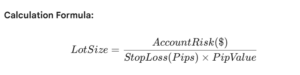
Calculation Formula:
$$Lot Size = \frac{Account Risk (\$)}{Stop Loss (Pips) \times Pip Value}$$
12. Conclusion: Discipline is the Only Holy Grail
Lot Size is not just a math problem; it is the quantization of greed and fear. In 2026, the most successful traders aren’t those with the best “predictions,” but those who manage their Lot Sizes with robotic discipline.
13. FAQs (Search Snippet Optimized)
What is the minimum Lot Size in 2026? Most brokers offer 0.01 (Micro), but many now provide 0.001 (Nano) for ultra-fine risk control.
Is a 1.00 Lot safe for a $1,000 account? Absolutely not. This is a 100:1 leverage move that can wipe an account in minutes.
Should I increase my Lot Size after a loss? Never. This is called “Martingale” trading and is the primary reason for retail account failure in 2026.